
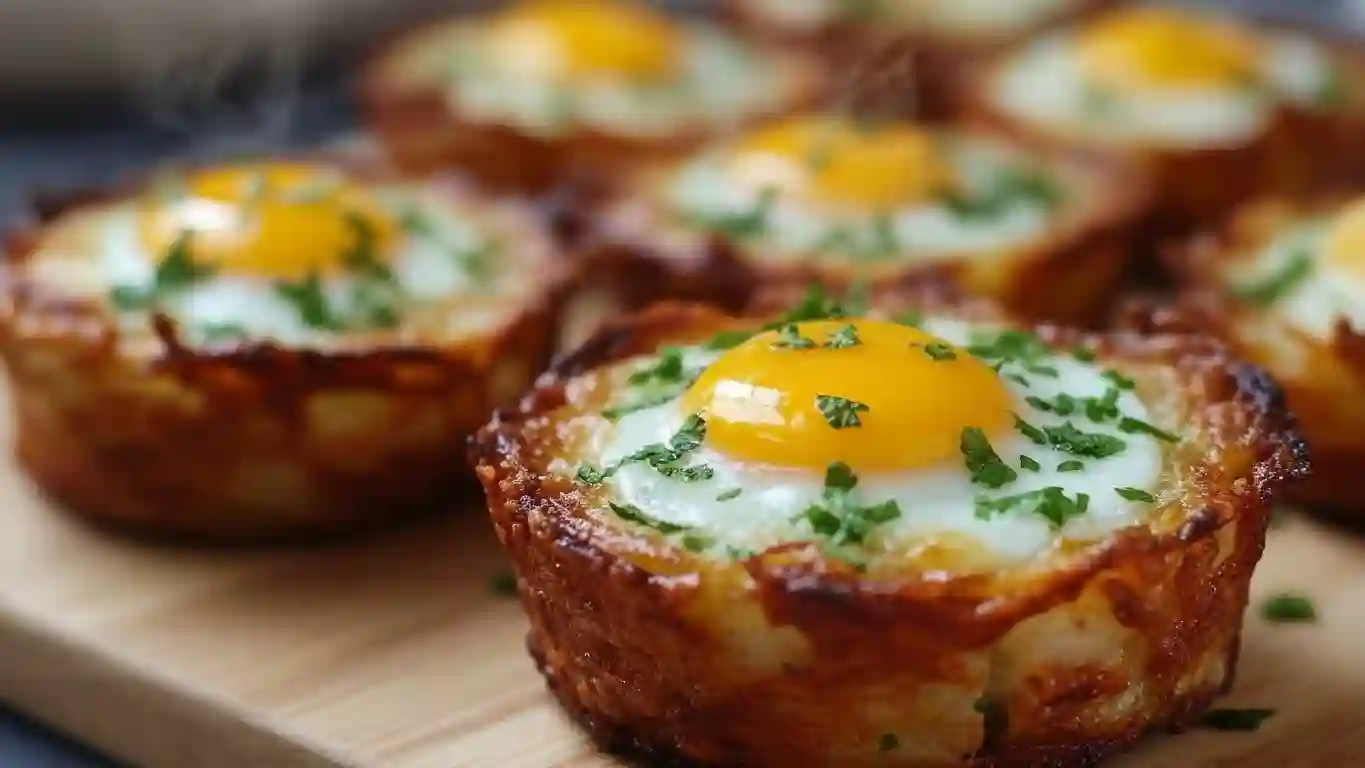
Eggs in Crispy Hash Brown Baskets transform the humble potato into a culinary masterpiece, merging the satisfying crunch of golden shreds with the rich, velvety texture of a baked egg. This guide provides a comprehensive, scientifically grounded approach to mastering this dish, ensuring perfectly crisp edges and non-stick success every time.
Ideal for high-volume brunch service or meal prepping, this method solves common culinary pitfalls like sogginess and adhesion. Whether you are seeking Gluten-free breakfast ideas or a visually stunning centerpiece for your morning table, this technique delivers consistent, restaurant-quality results.

Eggs in Crispy Hash Brown Baskets

Equipment
- Muffin Tin
- Mixing bowl
- Oven
- Kitchen Towel
Ingredients
Main Ingredients
- Cooking spray for greasing muffin tin
- 6 cups frozen hash brown potatoes completely thawed
- 2 tsp hot smoked paprika
- 1 tbsp fresh rosemary chopped, or 2 tsp dried rosemary
- 3 tbsp extra virgin olive oil
- 1/2 tsp kosher salt
- 1/2 tsp freshly ground black pepper
- 12 eggs
- 2 tsp chopped chives for garnish
Instructions
- Preheat oven to 375°F (190°C) and heavily grease a muffin tin with nonstick spray.
- Wrap thawed hash browns in a clean kitchen towel and squeeze out any excess moisture.
- In a large mixing bowl, combine potatoes, paprika, rosemary, olive oil, salt, and pepper. Stir until well coated.
- Divide the potato mixture evenly between muffin cups, pressing firmly to form a basket shape.
- Bake for 20–30 minutes or until golden and crispy.
- Remove from the oven and crack 1 egg into each hash brown basket. Season with salt and pepper.
- Bake again for about 15 minutes, or until eggs are set to your liking.
- Run a knife around the edges to loosen and gently remove the baskets. Garnish with chopped chives before serving.
Notes

Table of Contents
The Brunch Hero You Need
The Appeal of the Edible Nest
I vividly remember the first time I understood the true potential of the humble potato. It was in the kitchen of my elderly neighbor, Madame Dubois, a French expatriate with an uncompromising standard for texture. She once told me, “A potato without a crust is just a sadness on a plate.” That lesson stuck with me.
When we create Eggs in Crispy Hash Brown Baskets, we are essentially honoring that philosophy of texture. This dish is not merely breakfast; it is an architectural feat of culinary engineering.
The concept is deceptively simple yet gastronomically profound. You are building an edible vessel a nest constructed from shredded tubers. This vessel cradles a fresh egg, allowing it to bake gently within the protective walls of the starch.
The result is a magnificent contrast that delights the palate. You encounter the shattering crunch of the exterior, seasoned and browned to perfection, followed immediately by the tender, yielding whites and the rich, creamy yolk of the egg.
It is this interplay of textures the “crunch” versus the “cream” that elevates the dish beyond a standard Breakfast Hash Skillet. It transforms a rustic ingredient into something elegant and refined.
Why This Recipe Wins at Brunch
As someone who has hosted countless mid-morning gatherings, I can attest that the logistics of cooking eggs for a crowd can be a nightmare. Poaching eggs for ten people is a recipe for stress, and scrambled eggs often turn rubbery if left in a chafing dish.
This is where Hash brown egg nests truly shine as the ultimate brunch hero. They are inherently scalable. With a standard muffin tin, you can simultaneously prepare twelve individual servings, ensuring that every guest receives their meal hot and fresh at the exact same moment.
Furthermore, these nests are inclusive by design. In an era where dietary restrictions are common, serving Gluten-free breakfast ideas is almost mandatory. Since the “crust” is made entirely of potato rather than flour-based dough, it is naturally safe for those with celiac disease or gluten sensitivities.
The visual appeal cannot be overstated, either. There is an undeniable “cute” factor to these individual cups. They look bespoke and crafted, making them perfect for Classy Breakfast Ideas on special occasions like Easter or Mother’s Day.
When you bring a platter of these golden nests to the table, garnished with fresh herbs, it signals to your guests that you have put thought and care into their nourishment. It is a Easy Fancy Breakfast that looks difficult but, as you will see, is quite achievable with the right technique.
Choosing Your Ingredients: Fresh vs. Frozen
The Great Potato Debate: Frozen Hash Browns
In the world of culinary arts, there is often a stigma attached to frozen ingredients. However, when it comes to Hash brown egg cups, I am a staunch advocate for the freezer aisle.
Frozen vs. fresh hash browns for egg nests is a debate I have settled in my own kitchen long ago. The industrial freezing process actually aids us here. Frozen hash browns are typically par-cooked and dehydrated slightly before freezing, which gives us a head start on crispiness.
The convenience factor is undeniable. Peeling, shredding, and processing pounds of fresh potatoes is labor-intensive and messy. Using high-quality frozen shreds allows you to skip straight to the cooking process, making this one of the most practical Breakfast Recipes On The Go.
However, there is a critical step that beginners often skip, leading to disaster: the thaw. You cannot simply dump frozen ice crystals into your batter. You must allow the potatoes to thaw completely to room temperature. This is essential for the moisture-removal step we will discuss later.
Using Fresh Potatoes (For the Purists)
If you are a purist, or perhaps you have a garden full of tubers begging to be used, you certainly can use fresh potatoes. In my experience, the variety you choose is paramount to the structural integrity of your nest.
You must select a high-starch potato, such as a Russet. The starch is what helps the strands adhere to one another as they bake. Waxy potatoes, like Red Bliss or Yukon Gold, have a higher moisture content and lower starch, making them less suitable for achieving that rigid crust we desire.
Be prepared for the extra labor involved. Fresh potatoes contain a significant amount of surface starch and water. After grating them, you must rinse them thoroughly to prevent them from becoming gummy, and then crucially you must dry them even more aggressively than their frozen counterparts.
The Binding Agents
To ensure your Baked eggs in hash browns hold their shape and don’t collapse into a pile of loose shreds, we need a binding agent. Think of this as the mortar for your potato bricks.
Cheese is my preferred binder. A sharp cheddar or a dry Parmesan works beautifully. As the cheese melts, it permeates the gaps between the potato shreds. When it cools slightly, it solidifies, acting as a delicious, savory glue.
Fat is equally important for heat transfer. You have a choice between oil and butter. While butter offers superior flavor, it has a lower smoke point and contains water. For the ultimate crunch, I often use a mix of melted clarified butter (ghee) and a neutral oil.
For those needing extra structural assurance, particularly if you are making Make Ahead Breakfast Eggs for a large event, an egg white mixed into the raw potatoes can act as a protein binder. This coagulates during the par-bake, creating a very sturdy shell that can withstand handling.
The Secret Science of Crispiness (The “Squeeze” Method)
Moisture is the Enemy
If there is one scientific principle you must internalize to master Breakfast Ideas With Hashbrowns, it is this: moisture is the enemy of crispiness. It is a simple matter of thermodynamics.
When water is present in your potato shreds, the heat of the oven must first work to convert that liquid into steam. Until the water has evaporated, the temperature of the potato cannot rise significantly above 212°F (100°C).
Browning the Maillard reaction that gives us that delicious golden flavor and crunch only occurs at temperatures above 300°F (150°C). Therefore, if your potatoes are wet, you are steaming them, not roasting them. This leads to the dreaded “soggy bottom” that plagues so many amateur attempts at Hash Brown Egg Casserole.
How to make frozen hash browns crispy is not about higher heat alone; it is about removing the barrier to high heat. You must eliminate the water before the potatoes ever enter the oven.
The Cheesecloth Technique
I have developed a method I call the “Cheesecloth Squeeze,” and I consider it mandatory. Once your frozen hash browns are thawed, or your fresh ones are rinsed, place them in the center of a clean kitchen towel or several layers of cheesecloth.
Gather the corners of the cloth to form a pouch, and then twist. Twist hard. You must wring the bundle over the sink with significant force. You will be shocked by the amount of cloudy, starchy water that streams out.
Continue squeezing until you physically cannot extract another drop. When you open the cloth, the potatoes should form a solid, dry clump. They should feel tacky to the touch, not wet. This tackiness indicates that the starch is concentrated and ready to crisp up.
This step is the difference between a sad, limp pile of potatoes and a glorious, structural Copycat Cracker Barrel Hash Brown Casserole style crust.
Temperature Control
The second pillar of crispiness is thermal shock. We need the oven hot. I bake my nests at 400°F (200°C).
Many recipes call for 350°F, but I find this insufficient. At lower temperatures, the potato dries out slowly rather than frying in its own fat. We want the exterior to sear and caramelize quickly.
The high heat serves two purposes: it rapidly evaporates any remaining residual moisture, and it accelerates the browning of the cheese and oil mixture. If you attempt Sweet Potato Hash Browns using this method, be aware that the sugar content is higher, so they may darken faster, but the high-heat principle remains the same.
Equipment Essentials for Non-Stick Success
The Muffin Tin Dilemma
We must address a significant pain point: sticking. There is nothing more heartbreaking than creating perfect Hash brown egg nests only to have them disintegrate because they have fused to the pan.
How to keep hash browns from sticking to muffin tin is a top query for a reason. Standard aluminum pans are porous on a microscopic level. Even non-stick pans wear down over time.
You must be aggressive with your lubrication. A light spritz of cooking spray is rarely enough. I recommend using a pastry brush to coat each cavity with melted beef tallow, oil, or butter. The fat creates a barrier and also helps fry the bottom of the nest.
The Parchment Paper Hack
If you are using an older pan, or if you simply want 100% insurance against failure, I employ the parchment paper hack. Cut thin strips of parchment paper, about half an inch wide and five inches long.
Place one strip across the bottom of each greased muffin cup before pressing the potato mixture in. The ends of the strip should stick up above the nest like little tabs. After baking, you can use these tabs to lift the nest gently out of the tin without prying it with a knife.
Silicone Liners: The Ultimate Cheat Code
However, if you want to make Breakfast Ideas For 2 Adults or 20 without any stress, silicone muffin liners are the ultimate cheat code.
Silicone is naturally non-stick and flexible. You can place the liners on a baking sheet or inside a muffin tin. The heat transfer is slightly slower than metal, so you may need to add a minute or two to the cooking time, but the release is flawless.
Using silicone liners turns this from a “weekend project” into an easy, reliable option for Breakfast Hash Recipes during the busy work week. You can literally pop them inside out to release the nest intact.
Step-by-Step Instructions: Mastering the Nest
Phase 1: The Par-Bake (Don’t Skip This!)
The construction phase is where the magic happens. After mixing your dry, squeezed potatoes with your binder (cheese, oil, seasoning), place a scoop into each muffin cup.
Use a shot glass or the back of a measuring spoon to press the mixture firmly against the bottom and up the sides. You want to pack it tight. Loose shreds will not form a cohesive cup.
Now, you must par-bake. This means baking the empty nests before adding the egg. Place them in your 400°F oven for 15 to 20 minutes. You are looking for a deep golden-brown color on the edges. The nest must be fully structural and crispy before the wet egg is introduced.
Phase 2: The Egg Drop
Once the nests are golden, remove the pan from the oven and reduce the heat slightly if necessary (though I usually keep it high). Now comes the egg drop.
I never crack the egg directly into the nest. It is too easy to break a yolk or get a piece of shell in your Hash Brown Breakfast Ideas. Instead, crack the egg into a small ramekin or espresso cup first.
Gently pour the egg from the ramekin into the center of the crispy nest. This gives you control. If you are using large eggs and your nests are shallow, you may need to pour off a little of the egg white to prevent overflow.
Season the yolk immediately with salt and pepper. This is also the moment to add a sprinkle of herbs or extra cheese if you desire Hot Brunch Foods with a bit more flair.
Phase 3: The Final Bake & Yolk Timing
Return the pan to the oven. The duration of this second bake is critical and depends entirely on your preference for yolk consistency.
- Runny Yolk: Bake for 10–12 minutes. The whites should be opaque, but the yolk will still jiggle when you shake the pan.
- Jammy Yolk: Bake for 12–15 minutes. The yolk will be custard-like and soft but not flowing.
- Hard Set: Bake for 15+ minutes. This is ideal for Make-ahead brunch recipes where you might be eating them cold or reheating them later.
Flavor Variations & Dietary Swaps
The “Denver Omelet” Style
One of the joys of this recipe is its versatility. You can channel the classic diner vibe by creating a Denver Omelet version.
Dice green bell peppers and onions very finely. Sauté them briefly to remove moisture, then mix them into the raw potato shreds before par-baking. For the protein, dice turkey ham or beef bacon (remembering our exclusion of pork) and sprinkle it into the bottom of the nest before cracking the egg. This creates a robust, meaty flavor profile suitable for Breakfast Ideas American style.
Spicy Southwest Kick
For those who enjoy heat, a Southwest version is fantastic. I swap the cheddar cheese for Pepper Jack to infuse spice directly into the crust.
I also mix a pinch of cumin and paprika into the potato mixture. Top the egg with diced jalapeños before baking. Once they come out of the oven, garnish with fresh cilantro and a dollop of salsa. This variation brings a welcome zest to Brunch Ideas With Eggs.
Keto & Low Carb Alternatives
I am often asked for Keto hash brown substitute ideas. The potato is, unfortunately, high in carbohydrates. However, you can adapt this technique using cauliflower.
Use riced cauliflower instead of shredded potatoes. The moisture removal step is even more critical here cauliflower is mostly water. You must mix the dry cauliflower with egg and cheese to create a “dough” that can be pressed into the tin. The result is a lighter, vegetable-forward vessel that fits perfectly into a low-carb lifestyle.
Dairy-Free Options
If you are avoiding dairy, simply omit the cheese. The starch in the potato is often sticky enough to hold the nest together if you press it firmly.
Substitute the butter for a high-quality olive oil or avocado oil. The flavor will be slightly earthier, but the crunch remains. This makes the dish accessible to a wider range of guests, ensuring your Easy Fancy Breakfast can be enjoyed by everyone.
Storage, Reheating, and Make-Ahead Tips
Fridge & Freezer Storage
These nests are surprisingly resilient. If you have leftovers, they can be stored in an airtight container in the refrigerator for 3 to 4 days. I often make a double batch on Sunday to serve as Breakfast Ideas On The Go throughout the work week.
Can I freeze hash brown egg cups? Yes, you can. However, be aware that the texture of the egg white may change slightly, becoming a bit rubbery. To freeze, place the baked and cooled nests on a baking sheet in the freezer for an hour (flash freezing) before transferring them to a freezer-safe bag. This prevents them from sticking together.
Reheating Without Rubberizing
Reheating is an art form. Please, I beg of you, avoid the microwave if possible. The microwave excites the water molecules in the egg, often causing the yolk to explode or the whites to become tough and rubbery, while the potato becomes soggy.
The best method is the Air Fryer. Place the cold nest in the air fryer at 350°F for about 3 to 4 minutes. This revives the crispiness of the potato while gently warming the egg.
If you are reheating a large batch for a crowd, use the oven. Place them on a wire rack over a baking sheet (to allow air circulation) and bake at 350°F for 10 minutes. This ensures your Make-ahead brunch recipes taste just as good the second time around.
More easy Recipes To Try!
Cranberry Orange Shortbread Cookies
Frequently Asked Questions (FAQ)
What is the secret to crispy hashbrowns?
The secret is almost always moisture management. You must remove the water from the potato before cooking. The “squeeze” method using a cheesecloth is the most effective way to do this. Additionally, using enough fat (oil or butter) and high heat (400°F) ensures frying rather than steaming.
Can you mix eggs with hash browns?
Yes, but that creates a different dish, more akin to a frittata or a quiche. In Hash Brown Egg Cups, we keep them separate to maintain the textural contrast between the crispy shell and the soft egg. If you mix them, you lose that “nest” effect.
What does the phrase “eggs in one basket” mean?
While unrelated to the recipe, it is an idiom meaning to risk all one’s resources in a single venture. Ironically, with this recipe, putting all your Special Eggs in these baskets is a very low-risk, high-reward investment!
What do British call eggs in a basket?
In the UK, “eggs in a basket” often refers to “Egg in a Hole” or “Toad in the Hole” (though the latter typically involves sausages and Yorkshire pudding). It is fascinating how Breakfast Ideas American differ from our transatlantic cousins, but the love for eggs and starch is universal.